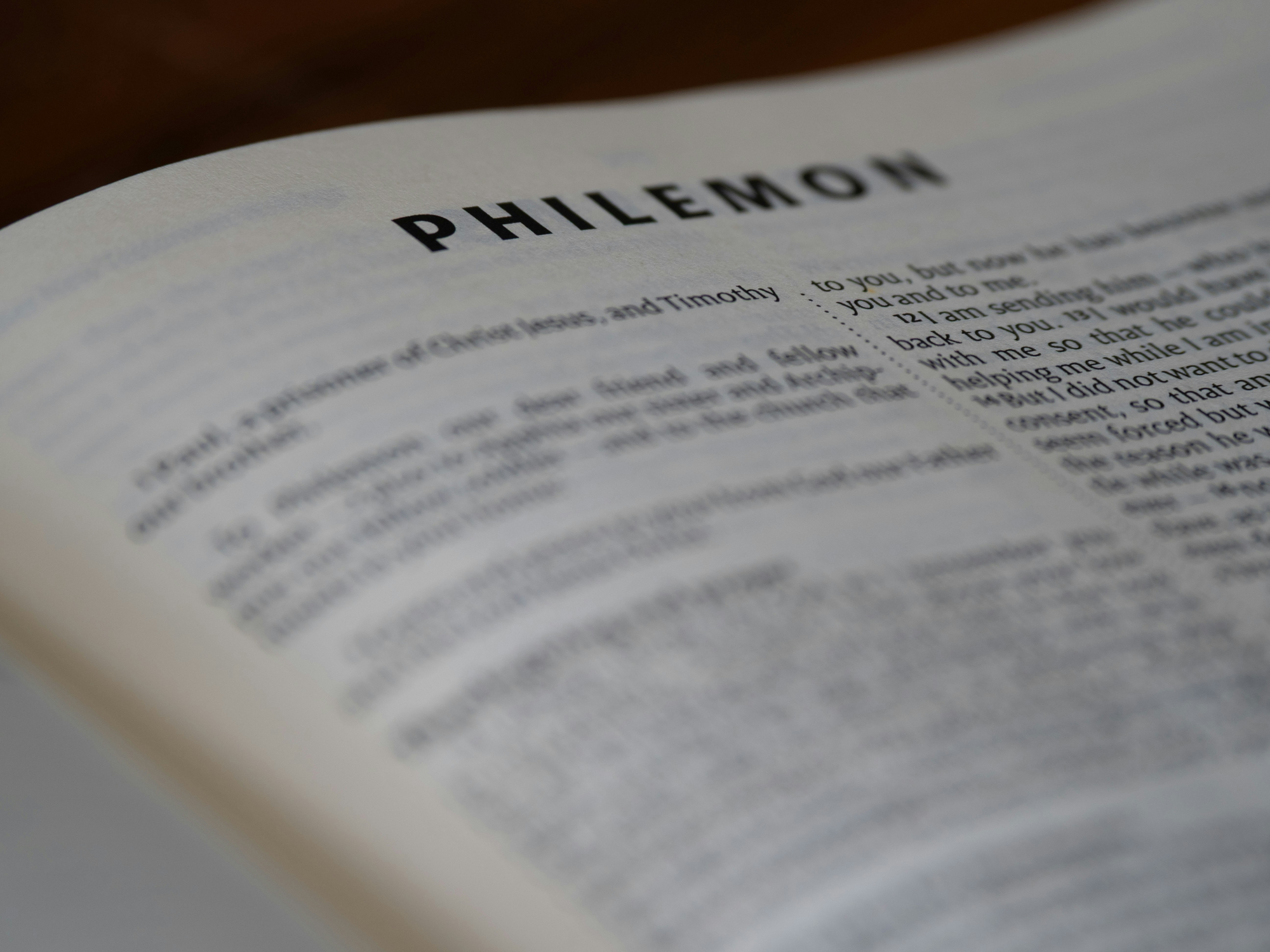
Philemon is Paul’s shortest letter.1 But its modest size is no reflection on its importance. Instead, Philemon’s brevity makes it an extraordinarily dense distillation of and entry point to “Paul, his worldview and his theology.”2
So, it should perhaps be no surprise to find not a few references to Philemon among the earliest writers after Paul. For a list of texts where early Christian writers refer to Philemon, the best current source is BiblIndex.3
Early Christian Writings and Their Translations
 For the Ancient Christian Study Bible, work is starting from standard English translations of early Christian works (where these are available).
So, for works where I’ve identified a corresponding English text, I’ve noted that translation below.
For the Ancient Christian Study Bible, work is starting from standard English translations of early Christian works (where these are available).
So, for works where I’ve identified a corresponding English text, I’ve noted that translation below.
Things change, however, and new translations appear. So, for instance, in 2004, David Hunter could lament how “there is currently no ET of any significant portion of Ambrosiaster’s work.”4 And by the end of 2009, English translations of all of Ambrosiaster’s commentaries on the Pauline letters could be available.5
So, feel free to reach out on Mastodon if you notice an update that’s needed in these lists. Comments are particularly welcome if you know of
- an English translation that’s available but isn’t listed or
- a better or more recent English translation that’s now available to replace an older translation.
Commentaries or Homilies on Philemon
For commentaries or homilies specifically on Paul’s letter to Philemon, there survive those by
- Ambrosiaster, In epistula ad Philemonem. Gerald Bray has translated this commentary into English in Commentaries on Galatians–Philemon, Ancient Christian Texts (affiliate disclosure; Downers Grove, IL: InterVarsity Press Academic, 2009).
- Chrysostom, John. Homiliae in epistulam ad Philemonem. Philip Schaff has revised these homilies Oxford translation in NPNF 1/13 (affiliate disclosure). This volume is also openly available online, as indexed in my online library guide.
- Jerome, Commentariorum in Epistulam ad Philemonem liber. Thomas Scheck has translated this commentary into English in St. Jerome’s Commentaries on Galatians, Titus, and Philemon (affiliate disclosure; Notre Dame: University of Notre Dame Press, 2010).6
- Theodoret of Cyr, Interpretatio Epistolae ad Philemonem. Robert Hill has translated this commentary into English in vol. 2 of Commentary on the Letters of St. Paul (affiliate disclosure; Brookline, MA: Holy Cross Orthodox Press, 2001).
Other Works
Besides commentaries or series of homilies, numerous other works from a wide variety of authors engage Philemon more or less substantively. Among these are works by
- Tertullian (160–230),
- Origen (185–254),
- Hilary of Poitiers (300–368),
- John Chrysostom (347–407),
- Jerome (347–420), and
- other authors that I’ll be working through soon.
Tertullian (160–230)
- Adversus Marcionem 5.21 (1×). Peter Holmes has translated this work into English in ANF 3 (affiliate disclosure), see esp. 473–74.
- Adversus Valentinianos 32 (1×). Alexander Roberts has translated this work into English in ANF 3 (affiliate disclosure), see esp. 518n23.
You can access the full text of ANF 3 via the link in my online library guide.
Origen (185–254)
- Commentarium in evangelium Matthaei (2×). BiblIndex references Erich Klostermann and Ernst Benz, Matthäuserklärung: Die lateinische Übersetzung der commentariorum series, Origenes Werke 11.2 (Leipzig: Hinrichs, 1933), 157 (line 1), 170 (line 11). The text is available on Internet Archive and falls in Origen’s discussions of Matt 25:15–19 and 35–41. Ronald Heine has translated Origen’s commentary in full, including the more fragmentary portions (affiliate disclosure; Oxford: Oxford University Press, 2018).
- De oratione, or Peri proseuchēs (1×). Origen’s oblique reference to Philemon comes in 29.15. Rowan Greer has translated this work in Origen: An Exhortation to Martyrdom, Prayer; First Principles: Book IV; Prologue to the Commentary on the Song of Songs; Homily XXVII on Numbers, ed. Richard J. Payne, Classics of Western Spirituality (affiliate disclosure; Mahwah, NJ: Paulist Press, 1979), 81–170 (see esp. 160).
- Homiliae in Jeremiam (2×). The references to Philemon comes in homily 20 (2). John Smith has translated Origen’s homilies on Jeremiah in Fathers of the Church 97 (affiliate disclosure; Washington, DC: Catholic University of America Press, 1998), 1–273 (see esp. 224). In this case, however, BiblIndex lists two references—one to v. 10 and one to v. 14. The reference to v. 14 is straightforward, but the reference to v. 10 is more difficult to discern both from Smith’s text and from Erich Klostermann’s edition upon which Smith mainly relies. BiblIndex cites P. Nautin’s Homélies XII–XX et Homélies latines, Sources Chrétiennes 238/Homélies sur Jérémie 2 (affiliate disclosure; Paris: Cerf, 1977). So, I’ll need to do some further checking in this critical text to evaluate this prospective reference.
Hilary of Poitiers (300–368)
- De Trinitate 4.39 (1×). E. W. Watson and L. Pullan have translated this work in NPNF 2/9, see esp. 83. Stephen McKenna has also provided The Trinity in Fathers of the Church 25 (affiliate disclosure; Washington, DC: Catholic University of America Press, 1954), see esp. 127.
- Tractatus super psalmos 68.27 (1×). E. W. Watson and L. Pullan translated Hilary’s comments on Pss 1, 53 (ET 54), and 130 (ET 131) in NPNF 2/9. But Hilary’s appeal to Philemon occurs in his discussion of Ps 68, which does not appear otherwise to have been translated into English already. Antonio Orazzo, however, has published two volumes of an Italian translation in Testi Patristici. Volume 1 appeared in 2005 on on Pss 1–91. Volume 2 appeared in 2006 on Ps 118 (ET 119) alone. The most current Latin edition is that of J. Doignon and R. Demeulenaere in CCSL 61 (2009; see esp. 336, line 11). This edition appeared in two preliminary installments (61A in 1997 and 61B in 2002) before the publication of the final, combined text. Before this edition, A. Zingerle published a Latin text in CSEL 22 (1891), as did J.-P. Migne in PL 9 (1844).
You can access the full texts of CSEL 22, NPNF 2/9, and PL 9 via the links in my online library guide. There, you’ll also find links to access Orazzo’s translation, which is partly open-access.
John Chrysostom (347–407)
Works Available in English
- Ad populum Antiochenum de statuis (1×). W. R. W. Stephens has translated this work into English in NPNF 1/9 (affiliate disclosure), see esp. 445–47.
- Ad Theodorum lapsum (1×). Stephens has translated this work into English in NPNF 1/9 (see esp. 109).
- De laudibus sancti Pauli apostoli (1×). Thomas Halton has translated this work into English as In Praise of Saint Paul (affiliate disclosure; Eugene, OR: Wipf & Stock, 2016).
- De Lazaro (3×). Catharine Roth has translated this work into English as On Wealth and Poverty, Popular Patristics Series (affiliate disclosure; New York: St. Vladimir’s Seminary Press, 2021). Before her, F. Allen translated it under the title Four Discourses of Chrysostom, Chiefly on the Parable of the Rich Man and Lazarus (London: Longmans, Green, Reader & Dyer, 1869). Allen’s translation appears to remain in print only on-demand from various sources with which I’m not familiar.
- Expositiones in Psalmos (2×). Robert Hill has translated this work into English as St. John Chrysostom: Commentary on the Psalms, 2 vols. (Brookline, MA: Holy Cross Orthodox Press, 1998) (see esp. 1:253, 2:82–113).
- Homiliae in Acta apostolorum (1×). George Stevens revised the translation of J. Walker, J. Sheppard, and H. Brown in NPNF 1/11 (affiliate disclosure), see esp. 133.
- Homiliae in epistulam ad Colossenses (4×). John Broadus has revised this work’s Oxford translation in NPNF 1/13 (see esp. 257, 310).
- Homiliae in epistulam ad Ephesios (2×). Gross Alexander has revised this work’s Oxford translation in NPNF 1/13 (see esp. 85, 89).
- Homiliae in epistulam ad Romanos (2×).7 George Stevens has revised the translation of J. B. Morris and W. H. Simcox in NPNF 1/11 (see esp. 336, 550, 556).
- Homiliae in epistulam ad Titum (1×). Philip Schaff has revised this work’s Oxford translation in NPNF 1/13 (see esp. 521).
- Homiliae in epistulam ii ad Corinthios (2×). Talbot Cambers has revised this work’s Oxford translation in NPNF 1/12 (affiliate disclosure), see esp. 343, 375.
- Homiliae in Matthaeum (1×). George Prevost has translated this work into English in NPNF 1/10 (affiliate disclosure), see esp. 278. But the reference to Onesimus has no associated note with a textual reference (cf. Col 4:9).
Works Openly Available in English
Of these works,
- NPNF 1/9–13,
- Allen’s translation of De Lazaro, and
- Halton’s translation of De laudibus sancti Pauli apostoli
are all openly available online. You can find direct links to each of these volumes in my online library guide.
Notes on Expositiones in Psalmos
Hill doesn’t index any references to Philemon in vol. 2 (see p. 397). But the key phrase is Chrysostom’s mention of Παῦλος δέσμιος Ἰησοῦ Χριστοῦ (PG 55:327; “Paul, a prisoner of Messiah Jesus”; translation mine).
In the NA28’s text of the Pauline corpus (affiliate disclosure), this phrase doesn’t appear. The closest parallels are
- Παῦλος ὁ δέσμιος τοῦ Χριστοῦ Ἰησοῦ (Eph 3:1),
- Παῦλος δέσμιος Χριστοῦ Ἰησοῦ (Phlm 1), and
- Παῦλος … δέσμιος Χριστοῦ Ἰησοῦ (Phlm 9).
Ephesians 3:1 is what Migne cites for the corresponding Latin text (Paulus vinctius Jesu Christi). But in this case, Chrysostom’s Greek text differs by dropping two articles and inverting Ἰησοῦ Χριστοῦ (“of Messiah Jesus”).
This latter change is common enough, although the NA28 doesn’t index any particular cases in these three texts. This change in order is also the only way in which Chrysostom’s quotation differs from the NA28’s text of Phlm 1 and 9. In addition, Paul uses this description twice in his comparatively short letter to Philemon. So, in principle, Philemon is likely to be the more prominent referent for this description.
In addition, Eph 3:1 and Phlm 1 regularly read as the NA28 has them.8 But for Phlm 9, the Majority Text has Παῦλος … δέσμιος Ἰησοῦ Χριστοῦ, the same order as does Migne’s text of Chrysostom.9 This confluence makes it still more likely that Chrysostom does refer to Philemon in this additional place in his exposition of the Psalms.
Chrysostom’s following sentence seemingly alludes to both Eph 6:20 and Col 4:3 (Καὶ πάλιν, Ὑπὲρ οὗ καὶ δέδεμαι ἐν ἀλύσει; PG 55:372). The elements aligning with Ephesians (e.g., ἀλύσει) could suggest the prior quotation is more likely to adapt Eph 3:1. The elements aligning with Col 4:3 (e.g., δέδεμαι) could suggest that it is more likely to adapt Philemon, given that Paul directly names Onesimus in Col 4:9. So, on balance, the greater verbal similarity with Philemon seems to make ti more likely that Chrysostom is referring to that text when he quotes Paul’s self-description as δέσμιος Ἰησοῦ Χριστοῦ.10
Works Unavailable in English
- De mutatione nominum (2×). This homily seems to be distinct from the general series on Acts, although it’s based on Acts 9:1.11 A Greek text and Latin translation are available in PG 51:113–56 (see esp. col. 149, line 12).
- In illud: Messis quidem multa (1×). This homily seems to be distinct from the general series on Matthew, although it’s based on Matt 9:37.12 A Greek text and Latin translation are availabile in PG 63:515–24 (see esp. col. 517, line 31). More recently, M. Aubineau has produced a critical edition under the title “Publication des Undecim novae homiliae de saint Jean Chrysostome (Patrologia Graeca (Migne) 63, 461–530): édition critique, comblement des lacunes, addition de deux inédits,” in Cappadocian Fathers, Chrysostom and His Greek Contemporaries, Augustine, Donatism and Pelagianism, ed. Elizabeth A. Livingstone, StPatr 22 (affiliate disclosure; Leuven: Peeters, 1989), 83–88.
Patrologia Graeca 51 and 63 are openly available online, and my online library guide can point you to how to access them.
Jerome (347–420)
Works Available in English
- Commentariorum in Epistulam ad Galatas (1×). Scheck’s volume that contains Jerome’s commentary on Philemon also contains the commentary on Galatians. In addition, David Hunter (ed.) and Andrew Cain (trans.) have provided the Commentary on Galatians in Fathers of the Church 121 (affiliate disclosure; Washington, DC: Catholic University of America Press, 2010), see esp. 65–66.
- Epistulae (1×). W. H. Fremantle, G. Lewis, and W. G.Martley translated Jerome’s letters in NPNF 2/6 (affiliate disclosure), see esp 172.
NPNF 2/6 is openly available online with a direct link available in my online library guide.
Works Unavailable in English
- Commentariorum in Isaiam (1×). Thomas Scheck has provided a translation of homilies 1–9 of the Commentary on Isaiah in Ancient Christian Writers 68 (New York: Newman, 2015). But the pertinent reference to Philemon comes in homily 18 (65.23). And that homily seems not yet to have an English translation. A Latin text is available in PL 24:9–678 (see esp. 648–51).
- De nominibus hebraicis (7×). A Latin text is available in PL 23:771–934.
Patrologia Latina 23 and 24 are openly available online, and my online library guide can point you to how to access them.
When using Patrologia Latina, you should always try to work with volumes published in 1865 or earlier. Beginning in 1868, a new edition of Patrologia Latina began to be issued. But this edition was based on new plates after the originals were destroyed and is unfortunately problematic in many respects.
Summary
Dozens of other references to Philemon appear in other literature from the first few Christian centuries. I’ll be working on digesting these too. But already, it’s clear these major works on Philemon are going to provide a lot of rich, fascinating material.
Discuss on Mastodon.
-
Header image provided by Brett Jordan. ↩︎
-
N. T. Wright, Paul and the Faithfulness of God, Christian Origins and the Question of God 4 (affiliate disclosure; Minneapolis: Augsburg Fortress, 2013), 23. ↩︎
-
It has yet to be released, but the University of Thessaloniki is in the final stages of preparing a project that will extend the data set already available from BiblIndex and provide direct links from results to corresponding pages J.-P. Migne’s Patrologia Graeca, 161 vols. (Paris, 1857–1886) and Patrologia Latina, 217 vols. (Paris, 1844–1864). ↩︎
-
David G. Hunter, “Fourth-Century Latin Writers: Hilary, Victorinus, Ambrosiaster, Ambrose,” in The Cambridge History of Early Christian Literature, ed. Frances Young, Lewis Ayres, and Andrew Louth (affiliate disclosure; Cambridge: Cambridge University Press, 2004), 315n51. ↩︎
-
In addition to the volume noted in the commentary list, see the companion Commentaries on Romans and 1–2 Corinthians, trans. Gerald L. Bray, Ancient Christian Texts (affiliate disclosure; Downers Grove, IL: InterVarsity Press Academic, 2009). ↩︎
-
For a list of Jerome’s commentaries and their translations into various modern languages, see Roger Pearse, “Jerome,” Roger Pearse: Thoughts on Antiquity, Patristics, Information Access, and More, 29 June 2015. ↩︎
-
Two entries in BiblIndex’s results for this work are duplicates of the remaining two. Thus far, however, I have been unable to find what the abbreviation
ARGis intended to designate. ↩︎ -
For a summary, see CNTR’s collations of Eph 3:1 and Phlm 1. ↩︎
-
For a summary, see CNTR’s collation of Phlm 9. ↩︎
-
Conceptually, the major aspects of work on the fathers’ use of Scripture is much the same as that of the New Testament’s use of the Old. So, for pertinent methodological reflections, see my “Aristotle’s Rhetoric and Paul’s Hermeneutic: A Proposal for Understanding Paul’s Interpretive Logic,” TrinJ 43NS (2022): 183–206; Sacred Texts and Paradigmatic Revolutions: The Hermeneutical Worlds of the Qumran Sectarian Manuscripts and the Letter to the Romans, Jewish and Christian Texts in Contexts and Related Studies 16 (New York: Bloomsbury T&T Clark, 2013), 47–55, 195–97. ↩︎
-
See Society of Biblical Literature, The SBL Handbook of Style, 2nd ed. (affiliate disclosure; Atlanta: SBL, 2014), 156. ↩︎
-
See Society of Biblical Literature, Handbook of Style, 156. ↩︎