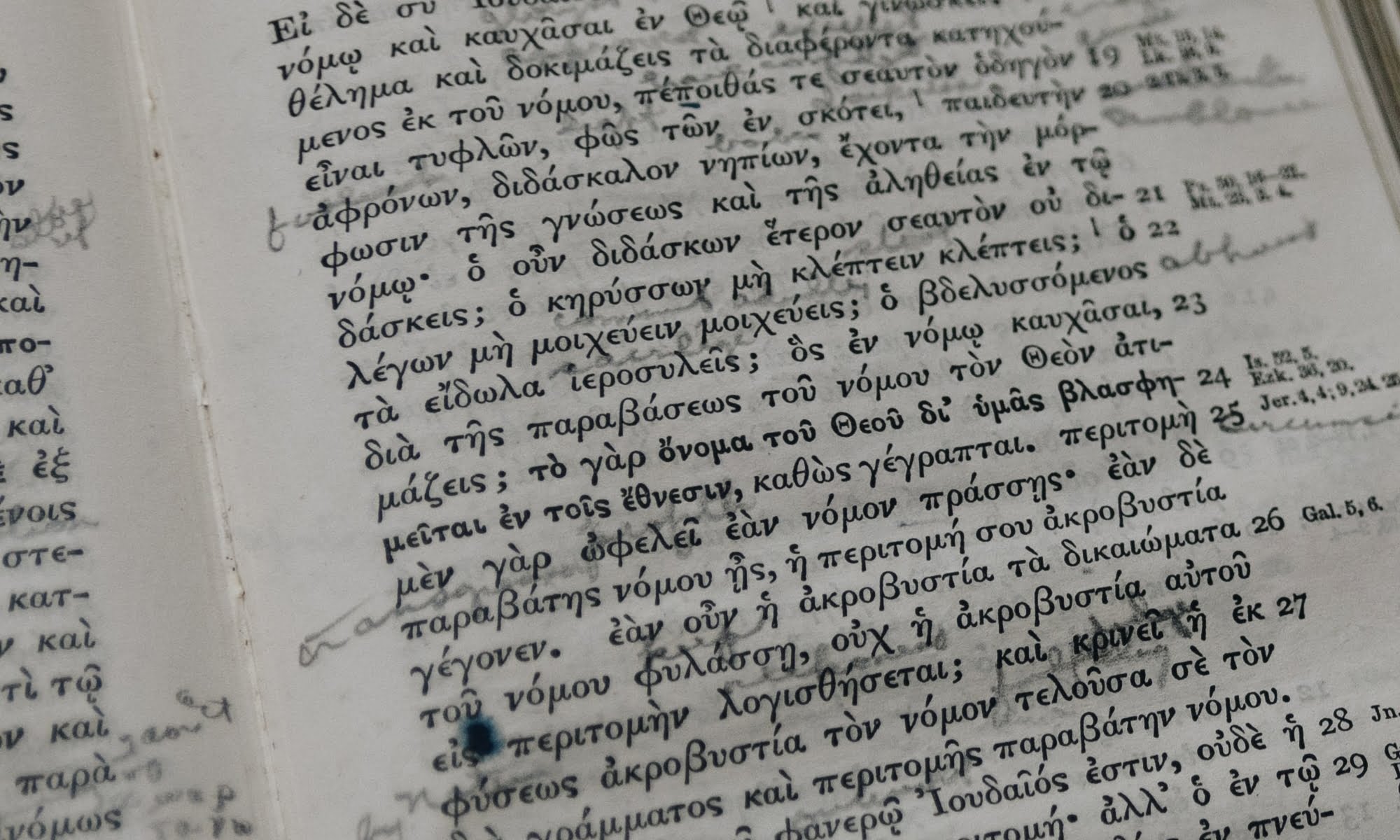
12 Reasons You Need to Read Your Bible
Critical biblical scholarship is irreplaceable. But even when you do this, there are 12 reasons you still need to read your Bible.
Critical biblical scholarship is irreplaceable. But even when you do this, there are 12 reasons you still need to read your Bible.

The ability to “see what is questionable” and to ask questions accordingly is the first step in choosing a good research topic.

At first glance, rhetoric and hermeneutics are quite different things. But, if we look more closely, they comingle in a way that makes them inseparable.
Daily Gleanings from Joe Gordon based on his book “Divine Scripture in Human Understanding.”
Daily Gleanings from Greg Goswell about reading Romans after Acts and from Carol Newsom about rhetoric and hermeneutics in biblical and ST literature.
Daily Gleanings from Freedom about the new Pause extension for Chrome and from Michael Kruger about contemporary cultural influences on the New Perspective.
Stephen Chan has a substantive essay on interaction between Jürgen Moltmann and Paul Ricoeur that focuses on the centrality of hope to Christian eschatology.
Scripture can speak for itself. But, those with Christian education vocations are specially bound to pass on its testimony and interpretation for their milieux.
From the morass of the unfamiliar and strange, humans seem to acquire language or other forms of understanding by known quantities.
Recently released under Wipf and Stock’s Pickwick imprint is Explorations in Interdisciplinary Reading: Theological, Exegetical, and Reception-historical Perspectives, edited by Robbie Castleman, Darian Lockett, and Stephen Presley. The volume includes essays assembled from the Institute for Biblical Research’s recently concluded study group on Biblical Theology, Hermeneutics, and Theological Disciplines. A key among the essays in the volume is the interplay between Scripture as situated in its own historical contexts and its continuing reception as a canonical whole. ...
In his 1963 essay on the “Phenomenological Movement.” H.-G. Gadamer discusses at length Edmund Husserl’s influence in founding the school. In so doing, he recounts an interesting habit of Husserl’s that In his teaching, whenever he encountered the grand assertions and arguments typical of beginning philosophers, he used to say, “Not always the big bills, gentlemen; small change, small change!” (133) Gadamer does not wholly underwrite Husserl’s program, but he does helpfully observe that—perhaps as much for theology as for philosophy: ...
Forthcoming this fall in P&R’s “Great Thinkers” series is Christopher Watkin’s volume on Jacques Derrida. According to the book’s blurb, Christian thinkers and writers who address Jacques Derrida’s philosophy face two potential pitfalls. One is to recast Christianity in an ill-fitting Derridean mold; the other is to ascribe to Derrida objectionable positions that bear little relation to his writing. ...
Mike Aubrey has provided an excerpt from an essay of his in Linguistics & Biblical Exegesis (Lexham, 2016). The excerpt strives carefully to work out a middle ground that is neither wholly on the side of theological lexica nor on that of James Barr’s critique of them. ...
In the last 2016 issue of the Bulletin for Biblical Research, Aaron Chalmers has an interesting essay on “the influence of cognitive biases on biblical interpretation” (467–80). Chalmers approaches the question from the perspective of cognitive psychology and focuses on “five key cognitive biases”—namely, “confirmation bias, false consensus effect, in-group bias, functional fixedness, and the illusory truth effect” (467). ...
Available in Fortress’s Ad fontes series is Biblical Interpretation in the Early Church, edited by Michael Graves.
Late last year, Books and Culture interviewed Richard Hays about some of his story and common themes in his work. Stemming from Hays’s similarly titled book, one of the questions addressed is “How is reading backward in a figural sense different from reading prophecy forward?” In response, Hays comments, in part, ...
Explorations in Interdisciplinary Reading: Theological, Exegetical, and Reception-historical Perspectives, edited by Robbie Castleman, Darian Lockett, and Stephen Presley, appeared under Wipf and Stock’s Pickwick in 2017. The volume includes essays assembled through the Institute for Biblical Research’s recently concluded study group on Biblical Theology, Hermeneutics, and Theological Disciplines. ...
In his On the Advantage of Believing, Augustine reflects on the necessity of belief but also on the danger of being overly credulous. He comments, in part, But now consider, you will say, whether in religion we ought to believe. For even if we concede that it is one thing to believe, another to be credulous, it does not follow that there is no fault in believing in religious matters. What if it be a fault to believe and to be credulous, as it is to be drunk and to be a drunkard? One who holds this view as certain, it seems to me, could have no friend. For, if it is base to believe anything, either he acts basely who believes a friend, or, in not believing a friend at all, I do not see how he can call either him or himself a friend…. For there is also no friendship at all unless something is believed which cannot be demonstrated by positive reasoning. ( Util. cred. 10.23–24) ...
Annually, the St. George’s Centre for Biblical and Public Theology sponsors three seminars at SBL: Scripture and Church, Scripture and Doctrine, and Scripture and Hermeneutics (in partnership with the Institute for Biblical Research). Registration is now open for these seminars’ 2017 meetings in Boston, as well as for the accompanying dinner. The lectures and discussion are always quite stimulating. ...
This month, Verbum has Joseph Fitzmyer’s Impact of the Dead Sea Scrolls (Paulist, 2009) available for free. The $0.99 companion volume is Fitzmyer’s Interpretation of Scripture: In Defense of the Historical-Critical Method (Paulist, 2008). ...
Craig Keener shares the following humorous diagram:
A while ago, I mentioned Sacred Texts and Paradigmatic Revolutions would be coming to paperback. That format is now available at about a fourth or less of the MSRP for the hardback.
At the end of chapter 1, “Questions of Truth and Epistemology,” in her Comical Doctrine: An Epistemology of New Testament Hermeneutics (Paternoster, 2006), Rosalind Selby summarizes: If this chapter has concluded with an appropriate understanding of the logical structure of grace and faith as we contemplate how it is that we know God, it must be important to pursue it in terms of the relationship between the individual and the community. The community of the ‘church’—however we define that—is founded by and founds its texts. This is a dialectic which itself rests in the priority of the founding acts of God. The priority over community, individual and the textual conveying of revelation always belongs with God; and the Christian will take that fundamentally seriously. ( 52; emphasis added) ...
In her Comical Doctrine: An Epistemology of New Testament Hermeneutics (Paternoster, 2006), Rosalind Selby has several insightful observations. Summarizing the thought of Karl-Otto Apel, Selby comments: Apel himself proposes a dialectical mediation of objective-scientistic and hermeneutical methods with a critique of ideology. Philosophical hermeneutics is reflexive in as much as the subject must self-objectify in order to be self-critical and avoid any hidden prejudices. ( 36) ...
The kind folks at Bloomsbury (the parent company of the T&T Clark imprint) have recently mentioned that a paperback release is forthcoming for my Sacred Texts and Paradigmatic Revolutions: The Hermeneutical Worlds of the Qumran Sectarian Manuscripts and the Letter to the Romans. Slated for this June, the paperback, at a $29.95 list price, will be a fiscally welcome complement to the current hardback ($120.00) and PDF ($27.99) formats. The paperback is already available for pre-order on Amazon, currently at just under the list price. ...
The latest Bloomsbury Highlights notes the newly available volume 16 in the T&T Clark Jewish and Christian Texts Series. The volume is a revision of my 2011 dissertation at Southeastern Seminary and primarily explores paradigmatic, or presuppositional, aspects of the hermeneutics at play in Romans and some of the Qumran sectarian texts. ...
[caption id=“attachment_2129” align=“alignright” width=“87”] Richard Bauckham[/caption] In his 2006 Jesus and the Eyewitnesses, Richard Bauckham suggests: that we need to recover the sense in which the Gospels are testimony. This does not mean that they are testimony rather than history. It means that the kind of historiography they are is testimony. An irreducible feature of testimony as a form of human utterance is that it asks to be trusted. This does not mean that it asks to be trusted uncritically, but it does mean that testimony should not be treated as credible only to the extent that it can be independently verified. There can be good reasons for trusting or distrusting a witness, but these are precisely reasons for trusting or distrusting. Trusting testimony is not an irrational act of faith that leaves critical rationality aside; it is, on the contrary, the rationally appropriate way of responding to authentic testimony. . . . It is true that a powerful trend in the modern development of critical historical philosophy and method finds trusting testimony a stumbling-block in the way of the historian’s autonomous access to truth that she or he can verify independently. But it is also a rather neglected fact that all history, like all knowledge, relies on testimony. ( 5; italics original) ...
The latest reviews from the Review of Biblical Literature include: Jewish Scriptures and Cognate Studies Keith Bodner, Jeroboam’s Royal Drama, reviewed by Mark McEntire Erhard S. Gerstenberger, Israel in the Persian Period: The Fifth and Fourth Centuries B.C.E., reviewed by John Engle Edwin M. Good, Genesis 1–11: Tales of the Earliest World, reviewed by Brian D. Russell Michelle J. Levine, Nahmanides on Genesis: The Art of Biblical Portraiture, reviewed by George Savran Emily Teeter, Religion and Ritual in Ancient Egypt, reviewed by Michael B. Hundley New Testament and Cognate Studies ...
Image:BTB vol 40 no 1.gif The latest issue of the Biblical Theology Bulletin includes: Article Callia Rulmu, “Stumbling Words for a Determined Young Lady: Notes on Ruth 2:7b” David H. Wenkel, “When the Apostles Became Kings: Ruling and Judging the Twelve Tribes of Israel in the Book of Acts” Coleman A. Baker, “Social Identity Theory and Biblical Interpretation” Eric C. Stewart, “New Testament Space/Spatiality”
[caption id="" align=“alignright” width=“175”] Louis Comfort Tiffany, “Window of St. Augustine” (Lightner Museum, St. Augustine, Florida; photo credit: Wikipedia)[/caption] Citing Varro as “a most learned man among the [pagans], and [a man] of the weightiest authority” on paganism ( Civ. 4.1 [ NPNF1 2:64]), Augustine summarizes Varro’s account of the naming of Athens ( Civ. 18.9 [ NPNF1 2:365]): ...