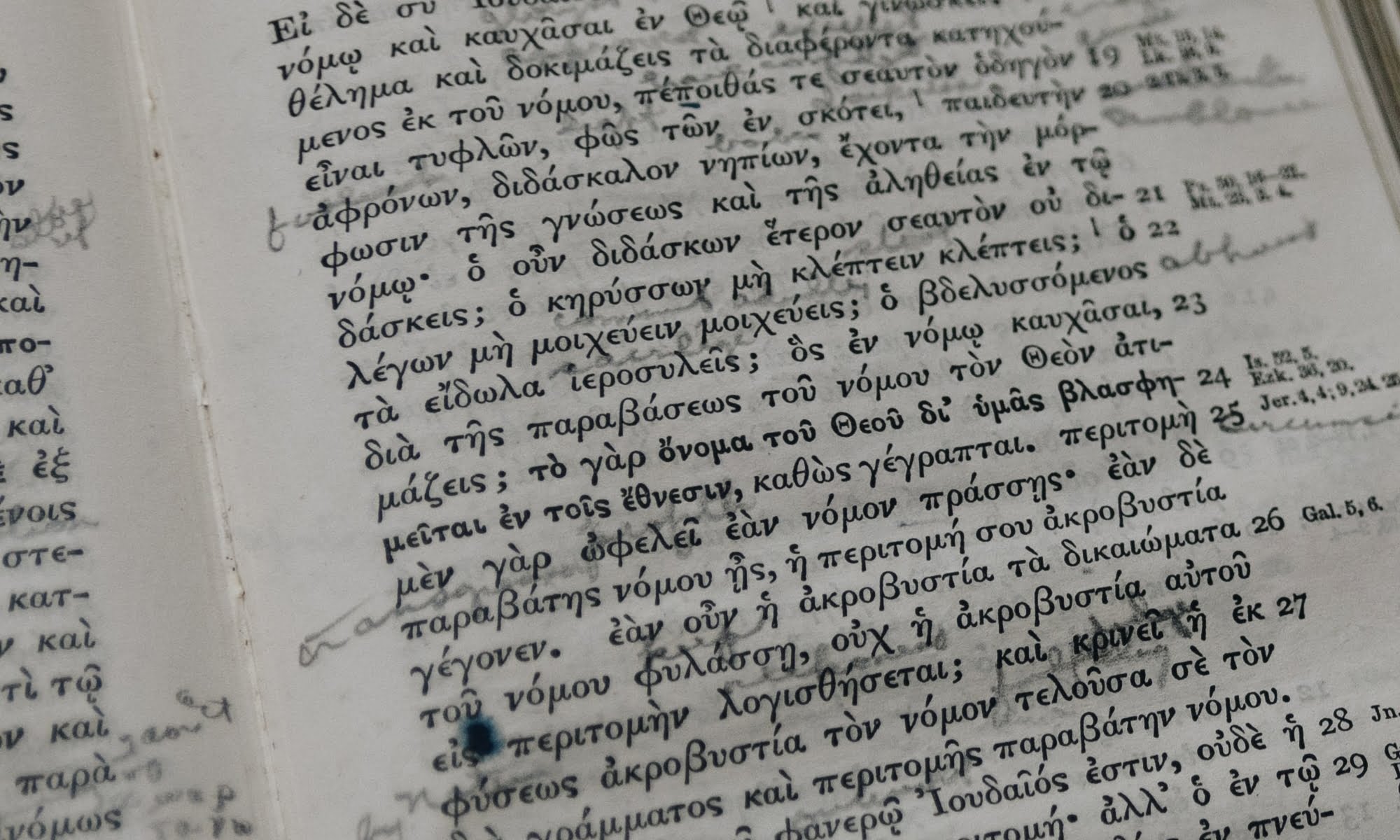
12 Reasons You Need to Read Your Bible
Critical biblical scholarship is irreplaceable. But even when you do this, there are 12 reasons you still need to read your Bible.
Critical biblical scholarship is irreplaceable. But even when you do this, there are 12 reasons you still need to read your Bible.

Expanding your research materials doesn’t have to break the bank. So much is already available through the libraries you have access to.
Daily Gleanings from Roger Pearse about the translation of the King James Version and AWOL about Brill’s “Digital Biblical Studies” series.
In an interview with Faithlife, Craig Bartholomew delivers a poignant challenge about the vocation of Christian academics for the broader world.
Scripture can speak for itself. But, those with Christian education vocations are specially bound to pass on its testimony and interpretation for their milieux.
Mark Hoffman has updated his list of “free Bible software and trial versions” to include more recent additions, as well as a number of online resources.
Due out from Baker Academic in January 2018 is R. W. L. Moberly’s “The Bible in a Disenchanted Age: The Enduring Possibility of Christian Faith.”
One of the less-than-ideal features of using an iOS device for editing or producing documents in Biblical Studies has been the difficulty of getting standard biblical language fonts (e.g., SBL BibLit) to work on the device. There are now, however, at least a couple solutions: Chris Heard has discussed how AnyFont can resolve the issue successfully and allow users to install SBL BibLit (or other fonts) onto iOS devices and use them within standard productivity tools (e.g., Pages, Word, Keynote, PowerPoint). In the App Store, AnyFont goes for $1.99. On the freemium side of things, Fonteer will also do the same thing. Fonteer’s free version allows users to install up to 3 fonts. So, if you anticipate only using this number or fewer, the free version will do the job. Fonteer premium (also $1.99 via in-app purchase) allows unlimited fonts to be installed. Below is an example of Fonteer working with a draft excerpt from my essay in Explorations in Interdisciplinary Reading ( affiliate disclosure). Example of Fonteer working with SBL BibLit ...
Choosing a platform for Biblical Studies software can be tricky, inasmuch as trying things out for yourself is probably the best mechanism for finding what will work for you. But, obviously, you want to do that trying out before you commit to one of the options. This process is now a bit simpler with Logos 7 Basic, which is available for free. ...
Biblicalhumanities.org is a community of computer scientists, Bible scholars, and digital humanists collaborating to create open digital resources for biblical studies. Our emphasis is on open resources for biblical languages, such as morphologically tagged texts, treebanks, and lexicons. We hope that these resources will be used widely for teaching, research, and resources used to read and study the Bible. ...
Mark Ward helpfully describes the syntax of searching for particular highlighting styles in Logos Bible Software.
Software that supports biblical and theological scholarship can be pricey, but Mark Hoffman has helpfully collected links to trial versions.
This month, Verbum has Joseph Fitzmyer’s Impact of the Dead Sea Scrolls (Paulist, 2009) available for free. The $0.99 companion volume is Fitzmyer’s Interpretation of Scripture: In Defense of the Historical-Critical Method (Paulist, 2008). ...
For Advent, Logos Bible Software is providing an additional and daily free or discounted book and media deal. Today’s book freebie is N. T. Wright’s Scripture and the Authority of God(SPCK, 2005).
The Journal of Biblical Literature 133, no. 2 includes: Joram Mayshar, “Who Was the Toshav?” Amitai Baruchi-Unna, “Two Clearings of Goats (1 Kings 20:27): An Interpretation Supported by an Akkadian Parallel” Ryan E. Stokes, “Satan, Yhwh’s Executioner” Saul M. Olyan, “Jehoiakim’s Dehumanizing Interment as a Ritual Act of Reclassification” John L. McLaughlin, “Is Amos (Still) among the Wise?” Christine Mitchell, “A Note on the Creation Formula in Zechariah 12:1–8; Isaiah 42:5–6; and Old Persian Inscriptions” Kristian Larsson, “Intertextual Density, Quantifying Imitation” J. R. Daniel Kirk and Stephen L. Young, “‘I Will Set His Hand to the Sea’: Psalm 88:26 LXX and Christology in Mark” Jennifer Knust and Tommy Wasserman, “The Biblical Odes and the Text of the Christian Bible: A Reconsideration of the Impact of Liturgical Singing on the Transmission of the Gospel of Luke” Brittany E. Wilson, “The Blinding of Paul and the Power of God:Masculinity, Sight, and Self-Control in Acts 9” Brice C. Jones, “Three New Coptic Papyrus Fragments of 2 Timothy and Titus (P.Mich. inv. 3535b)” Nicola Denzey Lewis and Justine Ariel Blount, “Rethinking the Origins of the Nag Hammadi Codices” This issue also introduces the “JBL Forum,” which is intended to provide “an occasional series that will highlight approaches, points of view, and even definitions of ‘biblical scholarship’ that may be outside the usual purview of many of our readers. The format may vary from time to time but will always include an exchange of ideas on the matter at hand” (pg. 421). This issue’s forum includes: ...
Emanuel Tov has posted a number of his publications online in openly-accessible, PDF format. Hearty thanks to Dr. Tov for this contribution to digital scholarship in biblical studies. HT: Tommy Wasserman.